
MrWin5 Notes
MrWin5 casino games, software and authenticity
 Available in US
MrWin5 is associated with a wide range of casino formats in an independent casino listing, from slots and jackpots to blackjack, roulette, baccarat and live games. The same review gives a catalogue count of 83 software providers. Those are meaningful clues to the breadth of the product being presented, but game variety and the authenticity of the underlying software are different questions. The same review raises a concern about imitation games associated with the casino, making the distinction central to any assessment of its catalogue.
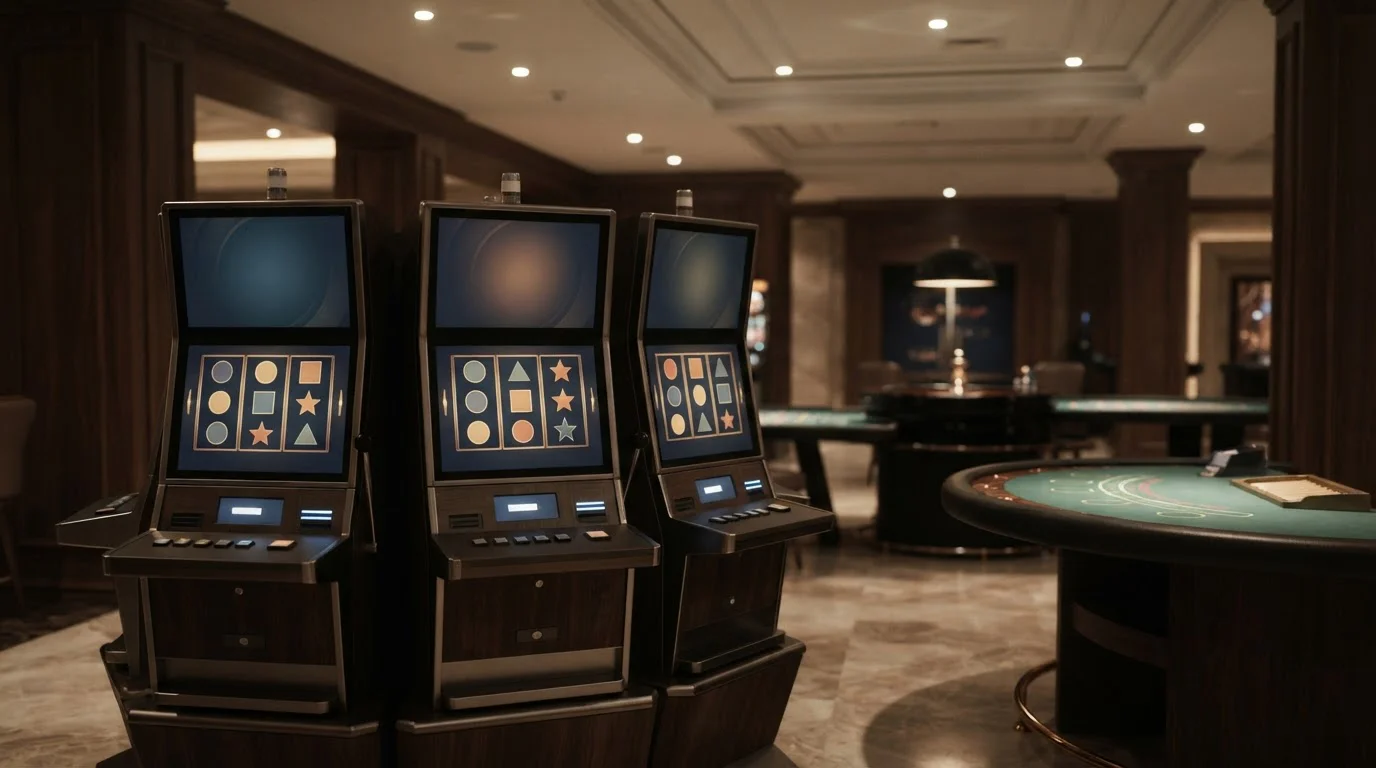
At a practical level, slots and live tables differ in their pace, mathematical structure and presentation, while the software supplier and the exact version of a game determine how its rules and returns are implemented. A familiar supplier name does not authenticate every image or game build bearing similar artwork. The detailed MrWin5 pokie title and studio guide examines the named title-and-studio examples in a separate catalogue, leaving the broader game types and integrity issues here.
Table of Contents
- Live tables and classic casino formats
- Game-build authenticity matters alongside variety
- The 83-provider catalogue and what its breadth signifies
- Pokies, jackpots and quick-round alternatives
- House edge, RTP and the limits of a single-session result
- Questions about MrWin5 games
- Breadth of games cannot settle software authenticity
Live tables and classic casino formats
The MrWin5 category list includes blackjack, roulette, baccarat and video poker, alongside a live-casino category. These formats have substantially different ways of presenting risk. Blackjack is a decision-based card game in which published rules can affect the long-run mathematical edge. Roulette revolves around a fixed set of outcomes with returns tied to the chosen bet type. Baccarat centres on wagers on the player, banker or tie outcome, with different underlying probabilities. Video poker is a computer-mediated draw game in which both the paytable and the decisions made matter.
Live casino adds a presentation layer: footage of a human dealer and a game table can be transmitted to players remotely. It is useful to distinguish a live broadcast from a video replay and a table game simulated entirely by software. The distinction influences how rounds are displayed and what information a player can inspect, but it does not itself supply a game-quality endorsement. A live dealer on screen is not an independent guarantee of the integrity of the back-end system.
| Listed format | Primary game mechanism | What governs outcomes or interpretation |
|---|---|---|
| Blackjack | Card decisions against a dealer | Rules on dealer drawing, doubling and payouts affect mathematical returns. |
| Roulette | Wagers on numbered or grouped results | Wheel configuration and payout table determine the long-run house advantage. |
| Baccarat | Comparing two hands | The type of bet changes the payout and expected return. |
| Video poker | Software-drawn cards and a paytable | Paytable and chosen holds can materially change expected results. |
| Live casino | Remote table presentation | Video delivery and underlying game procedures are separate aspects. |
The table describes the game formats rather than asserting which particular rule variants MrWin5 uses. For example, knowing that a roulette category exists does not identify the wheel configuration or every available betting limit. A category badge is therefore a useful entry point to understanding mechanics, while the exact game rules remain the basis for any mathematical comparison.
These distinctions also change how an unusually lucky or unlucky run should be interpreted. In roulette, a short series of repeated outcomes is possible without a mechanical anomaly. In blackjack, decisions and rules can alter theoretical expectations, although short-run results remain variable. Live presentation does not remove that variability. Treating a visual format as a promise of more predictable results would misrepresent how the games work.
Game-build authenticity matters alongside variety
Casino Guru reports that checks connected with a selection of MrWin5 games found imitation or fake games. It treats this as a major concern in its casino assessment. The finding concerns the examined selection; it does not establish that every game named in the catalogue is an imitation. The distinction matters because an apparently familiar game can still be delivered through software whose provenance is different from the version players expect.
A software studio supplies much more than a recognisable title. The actual build combines executable code, a set of rules, an approved or published paytable where applicable, and mechanisms for producing and recording outcomes. A copied name or illustration can make a substitute look familiar without proving that the original studio supplied or authorised the particular instance. Even when two screens look alike, their underlying mathematical models may differ.
What the name of a studio can and cannot tell you
- Catalogue association: a directory entry associates a supplier name with a casino listing; that alone is not evidence of a direct commercial or technical integration.
- Game identity: a matching title and artwork can help recognise a product family, but visual similarity is weaker than an authenticated build identifier.
- Rule implementation: game settings, available options and the implemented paytable determine behaviour beyond the branding.
- Software inspection: a technical test can examine the game build and its rules; the appearance of the lobby alone cannot establish the origin or behaviour of the software.
The practical consequence is not that every visually familiar title should be labelled counterfeit. The specific question is whether the executable content belongs to the supplier and version implied by its presentation. A reviewer warning that refers to a selection of games should remain about that selection. Extending it to every entry would obscure the difference between a specific integrity concern and a title-by-title finding.
Players can also encounter clone-like artwork in games that share a theme or design convention without being the same product. That makes careful wording important: genre similarity is not evidence of copying, and an authentic studio-branded game can have several legitimate variants. The integrity concern at MrWin5 comes from the reviewer’s examination, rather than from simply observing that its library includes familiar titles.
Software provenance matters because theoretical return figures and fairness representations apply to specific game builds and rules. A published return for one authentic version is not automatically transferable to a different implementation. If the build is misidentified, even an accurate description of a known game’s mathematics may be irrelevant to the software that was actually delivered.
The 83-provider catalogue and what its breadth signifies
The MrWin5 casino profile lists 83 providers. The named examples span widely known slot studios and suppliers associated with multiple casino formats: Pragmatic Play, NetEnt, Playtech, Play’n GO, IGT, Novomatic, Quickspin, Habanero, Aristocrat, PG Soft, JILI and Hacksaw Gaming. This is a third-party catalogue snapshot, not an audit of 83 contracts or independently tested integrations. It is useful as a picture of how the brand is presented in a casino directory.
Provider breadth can affect the mix of styles available in a game catalogue. Some studios are associated with reel-based games, others with live tables, mobile-first interfaces or specialised bonus mechanics. Yet the provider label is still one level removed from the actual game build. A count of suppliers measures how many names appear, not how many distinct engines are operating correctly or how many unique games a player can access at a particular moment.
Consider the practical difference between three measures: the number of provider names in a directory, the number of playable titles in a lobby, and the number of original software builds whose identity has been tested. The first is represented by the 83-provider listing; the other two require different evidence. Treating them as equivalent would overstate what a catalogue figure demonstrates. It would also overlook the integrity concern raised in the independent review.
Genre labels can overlap as well. A supplier might offer both conventional slot games and more experimental fast-round formats. A live-dealer platform may appear alongside a supplier of computer-simulated table games. In a single broad listing, the categories can describe delivery technologies, table types or game themes rather than mutually exclusive groups of titles.
The mobile and customer-support profile addresses a different part of that experience: the reviewer’s phone-format website images and its observed English live-chat interactions. A playable-looking interface and a responsive support channel are separate from game-build provenance, so they should be assessed on their own terms.
When comparing games, distinguish each game’s category, its attributed supplier and the version-specific rules that govern play. The first two often appear in public catalogues; the third comes from the actual software and any supporting test material. The presence of a well-known provider name is context, not a replacement for checking those layers.
Pokies, jackpots and quick-round alternatives
Slots or pokies are an important part of the MrWin5 product picture. The listing also includes jackpots, scratch cards, crash games and other compact formats. These games may share short rounds and animated interfaces, but their result structures are not identical. Conventional reel games combine symbols along paylines or other win evaluations. A jackpot feature adds a particular payout structure, sometimes involving prize pools. Scratch-style games reveal prearranged results through a different visual metaphor, while crash games use a rising multiplier and a stopping point.
For a game reader, the crucial distinction is between visual features and the mathematical rules behind them. Two slots with similar reels can differ in volatility, hit frequency, bonus features and the distribution of prizes. A jackpot display can make the largest prize visually prominent without indicating how frequently a prize occurs. In a quick-round game, the short interval between decisions may increase the number of wagers made during a fixed amount of time.
How repeated rounds change total exposure
- Define the round: distinguish one complete wager from a sequence of animations or bonus events that may represent the same paid play.
- Separate stake and turnover: the stake is the amount risked on one paid round; turnover adds the amounts wagered across all paid rounds.
- Read the rules rather than the theme: the paytable, special features and win evaluation determine the formal mechanics.
- Account for variability: a large theoretical jackpot does not make the typical short-session result predictable.
Rapid play can make a small nominal stake feel less significant, even though total money wagered accumulates with each decision. The same arithmetic is relevant to repeated table hands. A record of round count and stake is more informative than the last displayed win because it describes the amount exposed to a game’s long-run mathematical disadvantage.
Named game-and-studio pairings deserve a separate treatment because they introduce another layer of specificity. A known slot title can appear in a reviewer panel without proving that the original software was installed in a live casino instance. The dedicated pokie guide examines named catalogue examples and the difference between modern reviewer entries and historical site-description text.
House edge, RTP and the limits of a single-session result
RTP, or return to player, is a theoretical long-run percentage of wagered value returned by a game under the rules and assumptions used to calculate it. The house edge is the complementary expected share retained by the game operator across a very large number of wagers. Both are properties of a defined mathematical model, not a guarantee of what a particular person receives during an evening. A favourable short run can occur in a game with a mathematical disadvantage, and an unfavourable run can occur without proving that the stated model has changed.
Variance describes how widely results can fluctuate around an expectation. A high-volatility game may have long losing stretches punctuated by infrequent larger results. A lower-volatility design may distribute results differently. Neither pattern changes the basic principle that an expected result is not a scheduled outcome. A mathematical average becomes a useful description across many repetitions; it does not arrive at a particular time for an individual player.
A generic calculation starts with the number of paid bets multiplied by the average stake. That yields turnover. Multiplying the turnover by an illustrative house-edge fraction gives a modelled expected cost. This is useful for discussing exposure, but the result remains illustrative unless it uses the actual rules and returns for a specific authenticated game build. In particular, the number of supplier names in a casino catalogue cannot be substituted into a return calculation.
The homepage includes a session-cost illustration that lets the reader adjust hypothetical bet count, stake, edge and example budget. It does not measure MrWin5’s game returns. The point is to separate the money passed repeatedly through wagers from a starting deposit, an occasional win or the amount left in an account. Expectations help explain risk over repetitions, while the budget ratio simply compares two illustrative amounts.
Software identity and mathematics are linked: knowing a game’s advertised title is not enough to assign a particular return model. In a catalogue with an independent authenticity concern, it is especially important not to borrow theoretical figures from an unrelated game version. That is an analytical constraint, not a claim about a specific machine’s payout results.
Risk also extends beyond game mathematics. The payment-method analysis distinguishes card, bank-linked and blockchain transfer mechanics, including why moving funds into a service is separate from getting funds back. For gambling-related distress, confidential help is available from Gambling Help Online at gamblinghelponline.org.au or 1800 858 858. A separate legal-status analysis deals with authorisation questions rather than game mechanics.
Questions about MrWin5 games
Which game categories appear in the MrWin5 listing?
The listing includes slots or pokies, blackjack, roulette, baccarat, video poker, live casino, jackpots, bingo, keno, scratch cards and crash games.
How many software providers are listed for MrWin5?
The casino directory lists 83 providers in its MrWin5 catalogue snapshot. That count describes a directory listing, not a count of independently authenticated software agreements.
What is the game-authenticity concern about MrWin5?
The independent review checks identified imitation or fake games associated with MrWin5. The finding does not identify every listed title as an imitation.
Does RTP tell a player what one session will return?
No. RTP describes a theoretical long-run ratio across repeated play under a game’s mathematical model; a single session can differ substantially.
Read next
- MrWin5 overview
- Named pokies and studios
- Payment channels and financial exposure
- Australian legal position
Breadth of games cannot settle software authenticity
The MrWin5 listing spans pokies, table games, live formats and a substantial directory of supplier names. That breadth explains the apparent variety of the casino catalogue, while the independent game-authenticity concern addresses a different and more consequential issue: whether familiar-looking games use the original software implied by their titles. A collection of categories or provider labels cannot settle that question.
Understanding the product requires two separate readings. The format and rules describe what a game is meant to do; software provenance and build-specific mathematical details determine whether that description applies to the actual game delivered. Keeping those layers distinct gives the MrWin5 catalogue a more useful interpretation than either counting titles or treating every title as suspect.
Written by the editors at Mrwin5.